
HERITAGE STORE

COMPANY INFO
Heritage Store was originally established in 1969 in Virginia Beach, Virginia, and began as a provider of wellness products. By the 1970s, the store expanded into natural oils and gradually developed a broad product range. Today, Heritage Store offers an extensive line of body care, skin care, and hair care products, with black seed oil being part of the lineup, though it is not a primary focus of the brand.
● On March 20, 2025, we contacted the company via email requesting detailed information and any existing lab analyses related to their black seed oil. Unfortunately, we did not receive a response. As such, all of the information in this review was obtained through independent research using publicly available online sources.
It is worth noting that only three companies responded to our inquiries: Piping Rock, Bionatal, and Prime Natural.
PACKING AND SAFETY SEAL
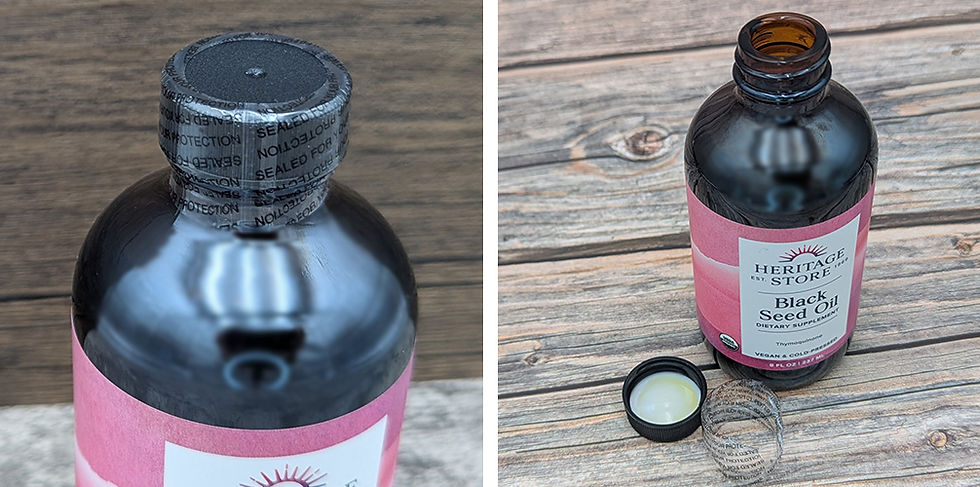
The oil comes in a standard amber glass bottle with a plastic cap, which is a common packaging format among U.S. black seed oil brands. A transparent shrink wrap is used for tamper evidence. Inside the cap, there is a standard liner, but no foil seal on the bottle neck.
● The sealing is insufficient to fully prevent leakage, especially during hot weather conditions, when black seed oil can expand by up to 20% during transportation.
SEEDS ORIGIN
There is no publicly available information regarding the origin of the seeds used in Heritage Store black seed oil. The only detail provided is on the side of the bottle label, which states that the product's country of origin is Israel.
Based on our analysis, it is unlikely that the oil is made from Israeli-grown seeds. While black seeds are cultivated in Israel, the harvest volume is small, and the seeds typically produce oil with very low bitterness, indicating a low thymoquinone (TQ) content about 0.2%. For commercial oil production, Israel generally imports black seeds from countries such as India, Syria, and Turkey. Therefore, although the oil may be bottled or processed in Israel, it is highly probable that the seeds are sourced from Turkey or other countries with larger-scale cultivation.
● An interesting observation: another brand, Zhou Nutrition, also lists “Product of Israel” on its label. Both Zhou Nutrition and Heritage Store products feature the USDA Organic icon and the CCOF (California Certified Organic Farmers) certification. This suggests that the original importer of the oil into the U.S. may have secured the certifications and required resellers to display them. Notably, no other brands we reviewed carry both certifications on their labels.
OIL DISCRIPTION
This black seed oil has a light yellow, cloudy appearance, accompanied by a pleasant herbal aroma and a moderate level of bitterness.
In our evaluation, the oil is virtually identical in color, flavor, and bitterness to several other brands, including Piping Rock, Zhou Nutrition, and well-known Turkish-origin oils such as Sweet Sunnah Premium, Kiva, Prime Natural, Maju, and Amazing Herbs Premium. It shows only minor differences when compared to Freshfield, Healths Harmony, Rawya, and Rawya Extra Strong.

THYMOQUINONE (TQ)
The TQ level is not listed on the Heritage Store black seed oil label or website. However, we found a Facebook advertisement image from August 2024 showing a bottle labeled with “3% Thymoquinone.”

The TQ level is not listed on the Heritage Store black seed oil label or website. However, we found a Facebook advertisement image from August 2024 showing a bottle labeled with “3% Thymoquinone.”
In reality, Israeli black seed oil — as analyzed in multiple studies conducted during investigations of "standardized TQ" — has been found to contain only around 0.20% TQ. This low TQ content results in oil with no bitterness, which does not match the profile of the Heritage Store oil we received. Instead, the oil we tested had moderate bitterness, supporting our conclusion that it is unlikely to be made from Israeli-grown seeds.
Based on our knowledge, a TQ level of 3% is typically only found in high-quality Ethiopian black seed oils. This might explain why the 3% claim eventually disappeared from the Heritage Store label—likely because it did not accurately reflect the oil's actual composition.
If, as our investigation suggests, this oil is of Turkish origin, its TQ content would likely fall within the range seen in other Turkish black seed oil brands (though none of these companies have publicly released official TQ lab certifications):
-
Maju, Rawya, Rawya Extra Strong – Minimum 2%
-
Sweet Sunnah Premium – 1.71%
-
Freshfield – 1.64%
-
Kiva, Prime Natural – Over 1.5%
-
Amazing Herbs Premium – Minimum 1.2%
● It’s important to note that, as experienced farmers have confirmed, TQ levels can vary even within the same country, depending on factors like farm elevation and regional climate. In Turkey, a country known for its mountainous terrain, elevation can differ significantly between farms. Additionally, the northern Black Sea coast tends to be cooler, while the southern Mediterranean coast is considerably warmer — both of which impact seed potency and TQ concentration.
TABLE OF ANALYSIS
Extraction oil videos & photos
NO
Acids pH level analyses
NO
Nigellon level
NO
Non-filtered oil with seeds
NO
Thymoquinone level
NO
Volatile Oils level
NO
Cold press method analyses
NO
Thymohydroquinone level
NO
Heavy Metals level analyses
NO
Thymol level
NO
Industry Clarifications:
(The following industry points are worth noting)
-
"Unrefined" ≠ Non-Filtered: Even unrefined oils are typically filtered and don’t contain seed particles.
-
"Cold Press" misuse on the label: The term is widely used without proof. True cold pressing should be validated by testing for compounds like Benzo(a)pyrene and related PAHs.
-
"Organic" ≠ Pesticide-Free: USDA standards still allow natural pesticides (§§ 205.601 - 205.602). No Nigella sativa seeds are entirely free from them.
-
"Non-GMO" claims are unnecessary: Nigella sativa is not genetically modified, and global demand doesn’t justify GMO cultivation.
FINAL RANKING #4-E
Positions #1 and #2 in our ranking are confidently held by the world’s most potent black seed oils—both extracted from Ethiopian Nigella sativa seeds.
Position #3 (with sub-positions A through D) includes several Turkish black seed oils that are slightly more bitter than the rest of the Turkish-sourced options. While they don’t match the strength of Ethiopian oils, they stand above the more common varieties in the market.
Position #4 is assigned to the remaining Turkish black seed oils, all of which demonstrate a standard, medium level of bitterness with no significant differences detected — even after thorough testing. Within this group, sub-positions are determined by product transparency, consistency, and accuracy in labeling.
Heritage Store and Zhou Nutrition fall short in these areas. Both label their oils as a “Product of Israel,” which can mislead consumers, as the oil is actually standard Turkish black seed oil with no special distinction. Because of this lack of clarity and transparency, Heritage Store is placed in sub-position “E,” falling below more transparent companies like Amazing Herbs, and even Sweet Sunnah with Piping Rock.
Additionally, Heritage Store ranks even lower than Zhou Nutrition due to a misleading claim about thymoquinone (TQ) content, which our team found to be false. This further impacts their credibility and lowers their overall standing in our ranking.
BRAND OWNERS:
If you represent or own one of the brands featured in our findings and would like to provide updates, corrections, or additional context, we welcome your input. Please don’t hesitate to get in touch with us through our Contact Form below. We’re committed to accuracy and transparency, and your feedback helps ensure that our content remains reliable and up-to-date.
CONSUMERS:
Are you a user of one of the products we’ve reviewed or mentioned? We’d love to hear from you! Whether you want to share your personal experience, offer feedback, or ask a question, feel free to reach out via our Contact Form below. Your insights are valuable and help us better serve the community.